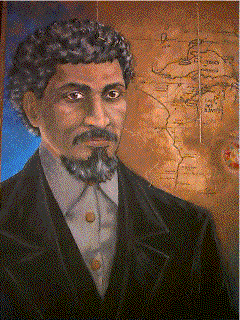
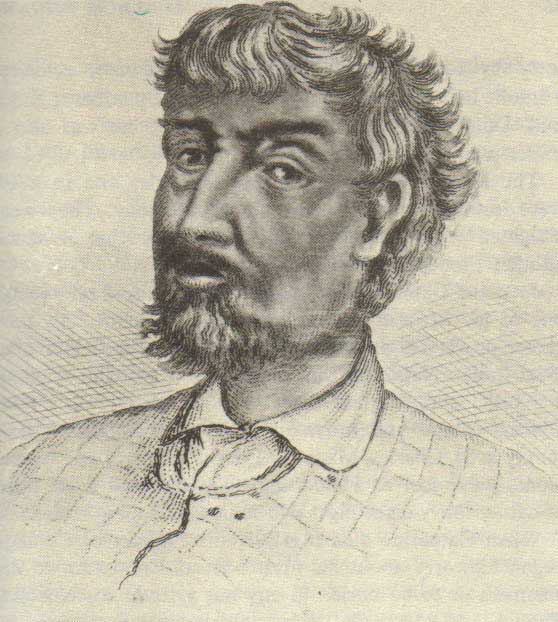
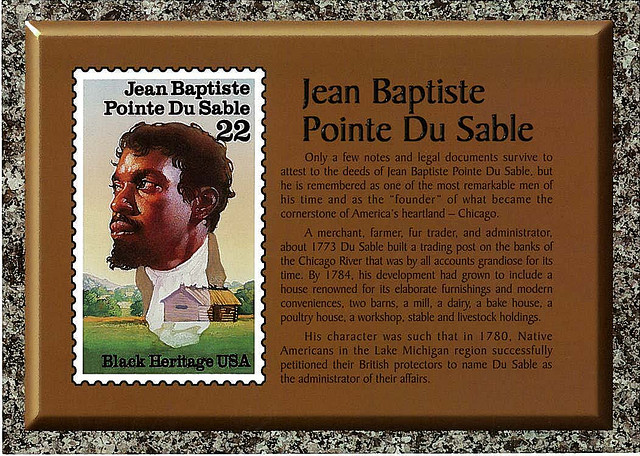
Jean Baptiste Point Du Sable was born in San Marc, Haiti, in 1745. His father was a French sea captian. He was sent to France for school. Later, he returned to Haiti to work on his father's ships. At the age of twenty, he went on a voyage to New Orleans with his friend Jacques Clemorgan.
They eventually travelled up the Mississippi River and settled in Peoria. Du Sable and Clemorgan met Choctaw, a Native American from the Great Lakes. They learned how to trap animals for their fur. Du Sable met Catherine, a Potawatomi woman. Du Sable and Catherine got married. They had two children. They lived in a small cabin which he enlarged it to a trading post. It turned into a small community with a church, school, and store. His trading post came very successful.
In 1778, British Soldiers were beginnig to build forts on Du Sable's land. Du Sable and the Indians fought the British for years over their land. In 1800, His son and wife died and Du Sable moved with his daughter, Suzanne, to St. Louis. He gave the farm to his grandchildren under the condition they would care for him and agreed to bury him in a Catholic cemetery.
On August 29, 1818, he died at the age of seventy-three. It was not till 1837 that Chicago became chartered as a city. However, it was founded many years before when Du Sable began his trading post beside the Chicago River.
In 1968, Jean Baptiste Point Du Sable was recogniszed as being the "Father of Chicago, Illinois."
Timeline
a. Birth Year--San Marc, Haiti, in 1745.
b. Death Year--On August 29, 1818, died in his sleep.
c. Around 1776, he set up a trading post at the mouth of the Chicago River called Fort Dearborn. The name Fort Dearborn was changed to Chicago in 1830.
d. Age at the year of their accomplishment--Approximately 31 years old when he started trading post.
Significance
Jean Batiste Point has influenced my life. First, I am able to go to Chicago and visit this great city he helped start. I love the baseball games, hockey tournaments, and field trips I have gone to in this city
Next, I learned from him that something can start out small and become bigger if you believe in it. Jean Baiste Point went from living on this land, to building a cabin, creating a trading post, and finally establishing a home for his children. Who would have thought it would also become a great city!
Source